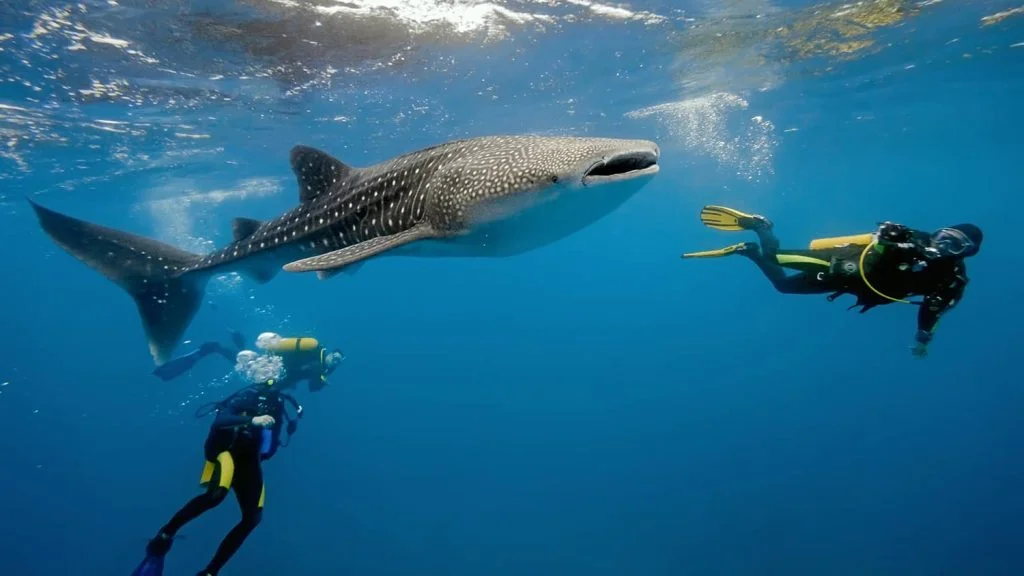
It was quiet the morning I slipped into the water. Not completely silent—there were soft splashes, the hum of the boat in the distance, a bird or two overhead. But underwater, everything slowed. I adjusted my mask, looked around, and there it was—just beneath me—a massive spotted figure gliding with the kind of grace only nature can create. A whale shark.
This wasn’t my first encounter with marine life, but it felt different. No crowd. No commotion. No feeding or chasing. Just presence. I didn’t reach out. I didn’t need to. Watching from a few meters away, I could feel the quiet power of simply being there.
In a world where everything is captured, uploaded, and consumed in seconds, choosing to witness something without interrupting it feels almost revolutionary. And in Saleh Bay, Sumbawa, this kind of experience is not only possible—it’s encouraged.
A Different Kind of Encounter
There are many places around the world to see whale sharks. From Mexico to the Philippines, they appear seasonally, often swarmed by boats and tourists eager for a selfie. But here in Saleh Bay, things move at a different pace.
The whale sharks Sumbawa is known for aren’t part of a show. They arrive in the calm waters of the bay because it’s rich with food. They linger near the fishing platforms, attracted by the presence of plankton and small fish stirred up during the local fishermen’s work. They’re not baited or lured. They come on their own terms.
And that’s exactly why the way we observe them matters.
Why “Look, Don’t Touch” Is More Than a Rule
One of the core values I felt on the Saleh Bay whale shark tour was this: you’re here as a guest. That means no diving directly on top of the shark. No loud splashes or attempts to ride, chase, or corner. Just observation. Just presence.
At first, it might sound limiting. But once you’re in the water, you realize it’s the opposite. It’s freeing. You’re no longer trying to “do something.” You’re part of something already happening—an underwater ballet that doesn’t need a human lead.
And when you take the pressure off interaction, you actually see more. You notice how the whale shark gently tilts its head toward a school of fish. You see the light patterns shifting on its spotted back. You feel the pace of the ocean—and yours—begin to sync.
The Beauty of Stillness
During my time in Sumbawa, I met a guide who had been working in the area for years. When I asked what made this place different, he didn’t talk about the size of the sharks or the visibility of the water. He said, “Here, the sharks trust the space. They’re not afraid.”
That stuck with me.
Because in many places, wildlife encounters have become loud, hurried, performative. People shout directions across the water. Drones buzz overhead. Fish are dumped in the sea to attract attention. And in the rush to get close, we often push what we came to admire further away.
But in Saleh Bay, the whale sharks keep returning. Maybe because here, people have learned how to watch without taking. To float without intruding. To stay still and just allow the experience to unfold naturally.
Ethical Wildlife Tourism in Action
The team behind Saleh Bay whale shark tour believes in more than just offering encounters. They’re helping shape a new model of eco-tourism in Sumbawa—one where education, community, and conservation work hand in hand.
Local fishermen are part of the process, not excluded from it. Visitors are briefed not just on safety, but on marine ethics. Group sizes are kept intentionally small. And there’s an emphasis on connection over consumption.
This isn’t about ticking a box on your travel list. It’s about remembering what it feels like to simply be there.
What You Really Take Home
I didn’t leave Saleh Bay with a viral video or a perfect underwater selfie. But I left with something harder to define—and far more lasting.
There’s something about floating quietly in the water, watching a 10-meter animal swim past you, that rearranges your perspective. It humbles you. It reminds you that we’re not separate from nature. We’re part of it. And the best way to honor that is sometimes to step back and let it be.
Traveling to see whale sharks in Sumbawa isn’t just about seeing something rare. It’s about choosing to witness it with respect. To lean into the moment instead of forcing it. To be a participant in nature, not a director.
And maybe, if more of us did that—not just in the ocean, but in life—we’d find more of the beauty we’re always chasing.